Visit the Palace of Versailles: History, Gardens, Events and Visitor Guide
The Palace of Versailles is one of France’s most iconic landmarks. Once the residence of kings and queens, it has become a powerful symbol of royal greatness, political influence and artistic excellence. Today, it remains an essential stop for anyone visiting Paris. From the Hall of Mirrors to the vast French gardens and seasonal fountain shows, Versailles offers a unique journey through French history and culture, taking you far beyond a traditional museum visit. To make the most of your visit, the Tootbus combo lets you combine Paris and Versailles in one experience, including transport to Versailles and a ticket to the Palace of Versailles.
In this guide, discover what to see inside the palace, the gardens and events not to miss, as well as practical tips to plan your visit.
A Royal Palace Shaped by History
From hunting lodge to royal masterpiece
The story of the Palace of Versailles begins in the early 17th century, when King Louis XIII built a modest hunting lodge in the countryside outside Paris. At that time, Versailles was a quiet rural area, far from the political centre of the kingdom. The original building was relatively simple, intended mainly as a private retreat for the king. It was under his son, King Louis XIV, that Versailles was completely transformed. Beginning in the mid-17th century, he launched major expansion works that turned the estate into a grand royal palace designed to reflect the absolute power of the monarchy.
Over time, successive building campaigns added new wings, ceremonial spaces and landscaped gardens, slowly turning the estate into a more prestigious royal residence. What started as a private retreat would eventually become one of the most important architectural projects in European history.
What you will discover inside Versailles
The Palace of Versailles is one of the most remarkable royal residences in the world, and stepping inside immediately reveals the scale of its artistic and political ambition. Among its many rooms, the Hall of Mirrors stands out as the most iconic space in the Palace of Versailles. Stretching over 73 metres and lined with 357 mirrors, it was designed not only as a display of luxury, but also to celebrate the political, economic and artistic successes of France under Louis XIV. The gallery reflected the power and prestige of the monarchy while serving as a setting for major ceremonies and diplomatic events. Today, it remains one of the highlights of any visit to Versailles.
Beyond this spectacular room, the Royal Apartments and State Rooms offer a deeper insight into court life. These richly decorated spaces were carefully arranged according to strict royal etiquette, reflecting the daily rhythm of the monarchy. The King’s and Queen’s apartments showcase elaborate interiors where every detail had a ceremonial or symbolic purpose, illustrating how power was expressed through architecture and design.
Throughout the palace, hidden details and symbolic elements reinforce this sense of authority. Painted ceilings, sculpted motifs and carefully chosen decorations were not simply aesthetic choices, but part of a wider political message that placed the monarchy at the centre of French life.
Gardens, Estate and Royal Escape
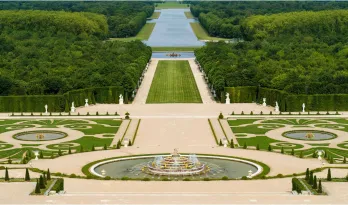
Outside the palace, the experience continues in the vast gardens designed by André Le Nôtre. These gardens are a masterpiece of classical French landscape design, where symmetry, order and perspective create a striking sense of control over nature. Long tree-lined paths, geometric flowerbeds and carefully aligned viewpoints stretch across the estate, offering constantly changing perspectives as you walk.
One of the most impressive features of the gardens is the system of fountains and water displays. During selected seasons, they come alive with the Musical Fountains Shows, where water jets are synchronized with classical music. This combination of sound, movement and landscape transforms the gardens into a dynamic open-air experience that changes throughout the day.
Further away from the main palace lies the Estate of Trianon, a more intimate and peaceful part of Versailles. The Grand Trianon was used as a private retreat by the royal family, while the Petit Trianon is closely associated with Marie-Antoinette, who preferred its quieter atmosphere.
Events and Experiences at Versailles
Beyond its royal history and remarkable interiors, Versailles offers seasonal experiences that transform the estate throughout the year.
From spring to autumn, visitors can discover the Musical Gardens and the Musical Fountains Shows. Accompanied by baroque music, these experiences reveal the beauty of the French gardens, with groves that are opened especially for these events and, on selected dates, fountains that are brought to life with water displays. In 2026, the Musical Fountains Shows take place every Saturday and Sunday from 4 April to 1 November, with additional dates on selected Tuesdays, while the Musical Gardens run from Tuesday to Friday between April and October.
As evening falls, Versailles takes on a completely different atmosphere during the Night Fountains Shows. Illuminated fountains, artistic light installations and a fireworks finale over the Grand Canal create one of the most memorable experiences of the season. For a hassle-free experience, choose a package including round-trip transportation from Paris and entry to the Versailles Night Fountains Show. Selected evenings can also be combined with the Royal Serenade, an immersive performance inside the palace where performers in period costumes bring the splendour of the royal court back to life.
Planning your visit
Visiting Versailles requires a bit of planning due to its size and popularity. Several ticket options are available depending on what you wish to explore, from access to the palace only to full entry covering the gardens and the entire estate. Booking in advance is highly recommended, especially during peak travel seasons, to ensure a smoother experience.
The palace is accessible from Paris via the RER C train, via a journey of around 50 minutes, making it an ideal day trip from the capital. For a simpler option, the Paris Discovery package combines transport to Versailles with a ticket to the Palace of Versailles. Once on site, visitors should plan to spend at least half a day exploring, although a full day is recommended to fully appreciate both the palace and the gardens without rushing.
The best time to visit Versailles is generally during spring and summer, when the gardens are in full bloom and most seasonal events take place. Arriving early in the day also helps avoid the largest crowds and allows for a more enjoyable visit.
Tips, Fun Facts and Local Secrets
Life at Versailles was highly structured, with court etiquette dictating almost every aspect of daily life. Even simple actions such as meals or waking up followed strict ceremonial rules, reflecting how the palace was designed to centre everything around the King.
Despite its grandeur, Versailles also hides quieter, more unexpected aspects. Beyond the main halls and formal rooms, the estate includes spaces and details that reveal how the palace has evolved over time, offering a different perspective on royal life beyond its official image.
One of the most fascinating figures associated with Versailles is Marie-Antoinette, who sought refuge at the Petit Trianon and the Queen’s Hamlet. These more intimate spaces contrast sharply with the formality of the main palace and offer a glimpse into a more private side of royal life.
Need some inspiration for exploring Paris?
Beyond Versailles, Paris offers an endless variety of cultural experiences, neighbourhoods and landmarks to explore. Complete your trip with a visit to world-renowned museums such as the Louvre and the Musée d’Orsay, or discover iconic landmarks like the Eiffel Tower. Uuncover some surprising stories by exploring 10 fun facts about the Eiffel Tower. From artistic and architectural masterpieces to historic streets and vibrant districts, Paris is full of unforgettable experiences waiting to be discovered.