History of Parc du Cinquantenaire: 5 Architectural Secrets to Discover in Brussels
Planning your stay in the Belgian capital? Let us take you to the heart of one of the city's most majestic spaces. With its spectacular perspectives, elegant gardens, and neo-classical palaces, Parc du Cinquantenaire (or Jubelpark to locals) is the true green and cultural lung of the capital.
But beneath its quiet park appearance lie incredible anecdotes, artistic rivalries, and hidden treasures. Whether you are a history buff or just curious, every monument in the park tells a chapter of the city's memory.
Leopold II, the "Builder King" of Brussels
To understand the sheer scale of the Cinquantenaire, we must go back to the end of the 19th century. King Leopold II ruled over Belgium with a boundless ambition: to transform Brussels into an imperial capital capable of rivaling Paris or London. He wanted grand perspectives, huge parks, and monuments that would impress visitors. This is how he set his sights on the Linthout plateau, a sandy area on the edge of the city at the time, to build this great public park and extraordinary monumental complex.
The 1880 Jubilee: Celebrating Belgium's Independence
The perfect opportunity to make this dream a reality came with the fiftieth anniversary of Belgium's independence, planned for 1880. Leopold II tasked architect Gédéon Bordiau with designing a massive exhibition palace surrounded by a 30-hectare park. This was the start of a monumental project. This green space would successively host the National Exhibition of 1880 and then the prestigious World's Fair of 1897, marking Belgium's industrial golden age and the rise of its art scene. The park's history begins here, forever linking nature with monumental architecture.
The 5 Architectural Secrets of Parc du Cinquantenaire
Secret 1 : The Triumphal Arch That Almost Never Saw the Light of Day
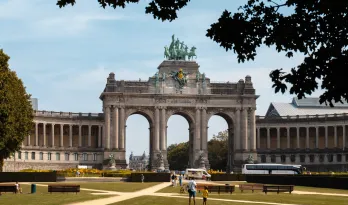
It is the symbol of the park, and yet, it almost remained a mere project. For the 1880 inauguration, Gédéon Bordiau designed a monumental triumphal arch with three arches (the Cinquantenaire Colonnade). But due to a lack of time and budget, only a temporary structure made of iron and wood was erected.
As the years passed, public funds ran dry, and the project stalled. Furious to see his masterpiece unfinished, Leopold II decided to personally fund the remaining work using his private fortune. He cast aside the original plans and called upon French architect Charles Girault (famous for the Petit Palais in Paris). Girault designed the stone arch we know today, which was finally inaugurated in 1905 for the country's 75th anniversary. A truly royal race against time that left its mark on the capital's history.
How to get there?
Get off at stop number 5 on the blue line.
Secret 2 : The Scandalous Pavilion of Human Passions
Tucked away in a shaded corner of the park is a small Greek temple of rare elegance. This is the Pavilion of Human Passions, the very first public work by the famous Art Nouveau architect, Victor Horta.
Inside, sculptor Jef Lambeaux created a monumental marble relief depicting the pleasures and sufferings of humanity, a true masterpiece of sculptural art. But upon its inauguration in 1899, it caused a massive shockwave. The naked, intertwined, and tormented bodies were deemed far too daring and cyclopean for the conservative society of the time. Faced with the controversy, authorities had the pavilion's entrance bricked up. This incredible stone gallery remained virtually closed to the public for over 115 years. Even today, it opens only on rare occasions, keeping all of its mystery intact.
Secret 3 : The Hidden Masterpiece of the Bronze Quadriga
If you look up at the top of the Triumphal Arch, you will spot a majestic chariot pulled by four horses: the Bronze Quadriga. This monumental sculpture represents "Brabant raising the national flag," surrounded by allegorical figures.
The monument is the result of a unique collaboration between two rival Belgian sculptors, Thomas Vinçotte and Jules Lagae, who had to set aside their differences to complete the artwork on time. Another key architectural detail: at the base of the majestic Doric columns of the hemicycle stand eight other statues. They represent the eight other Belgian provinces of the time, standing guard around the central arch and forming a true open-air statuary gallery.
Secret 4 : The Casts Workshop: The Secret Sanctuary of World Masterpieces
Did you know that the Cinquantenaire is home to one of the last active plaster cast workshops in the world? Tucked away under the roofs of the Art & History Museum, this workshop founded in the 19th century boasts a unique collection of over 5,000 historic molds.
These plaster molds allow craftspeople to reproduce world-class sculptural masterpieces, from Roman Antiquity to Michelangelo's Renaissance, identical to the millimeter. It is here, away from public view, that the museum preciously preserves the official and original mold of the famous Manneken-Pis. The workshop continues to use these ancestral techniques today to restore art and collections for museums worldwide.
Secret 5 : The Secret Belvedere and Its Panoramic Terrace
Many visitors admire the Triumphal Arch from below, but did you know you can go all the way to the top? By entering through the Royal Military Museum, you can take an elevator (and a few stairs) to reach the Belvedere of the Colonnade.
From this secret panoramic terrace located right beneath the hooves of the Bronze Quadriga, you will enjoy a spectacular 360-degree view of all of Brussels. On one side, the historic gardens of the park; on the other, the soaring glass skyscrapers of the European Quarter. It is one of the most spectacular and least-known viewpoints in the city, perfect for looking back at the capital's history from above.
How to get there?
Get off at stop number 5 on the blue line.
Other Must-See Activities in the Heart of the Park
Once you have uncovered the park's architectural secrets, extend your day by enjoying the incredible cultural offerings on-site. The Cinquantenaire is home to three exceptional museums where art and history meet:
Autoworld: Housed under a splendid Eiffel-style metal hall, this museum retraces the history of the automobile with over 250 legendary vehicles, from early carriages to modern supercars. It is a true open-air museum for motoring enthusiasts.
The Royal Museum of the Armed Forces and Military History: Impressive in scale, it features a massive aviation gallery where historic fighter planes are suspended in mid-air, alongside an impressive collection of armored tanks.
The Art & History Museum: One of the largest art museums in Europe, perfect for traveling through time, from mysterious Egyptian mummies to the pre-Columbian art gallery.
After all these visits, do as the locals do: enjoy the peace of the park, stretch out on the vast lawns for an impromptu picnic, grab a cold Belgian beer at Guinguette Maurice (during the summer season), or walk 5 minutes to Place Jourdan to taste legendary Belgian fries at Friterie Antoine.
How to get there?
Get off at stop number 5 on the blue line.
The Best Way to Discover Brussels and the Cinquantenaire
Opt for the Tootbus Tourist Bus
To explore Brussels in complete freedom and save your legs, the Brussels tourist bus is your best ally.
Our hop-on hop-off Brussels tour has a stop ideally located right at the entrance of Parc du Cinquantenaire. You can hop off the bus to explore each museum, stroll through the park, admire an art gallery, picnic under the shade of the trees, or photograph the Triumphal Arch, and then hop back on whenever you like. Comfortably seated on the open top deck of our eco-friendly bus, you will enjoy a breathtaking, open-air view of the capital's most beautiful monuments for a memorable and stress-free discovery of Brussels.
How to get there?
Get off at stop number 5 on the blue line.